
Shipping Software Without Fear: Part 1
Why calm deployments depend on reliable tests, monitoring, rollback plans, automation, and smaller releases.
Teams often move slowly not because developers lack skill, but because deployments feel unsafe.
When a release feels risky, every decision around it becomes heavier. A small change starts to require long discussions. A deployment window becomes a source of anxiety. Engineers wait for the perfect moment, stakeholders ask for extra reassurance, and the team begins to treat shipping as an event instead of a normal part of building software.
That hesitation is usually not a sign that the team is incapable. It is a sign that the system around delivery is not giving people enough confidence.
Healthy teams ship calmly because the system reduces uncertainty.
Unreliable Tests Create Doubt
Tests are supposed to answer a simple question: is this change safe enough to release?
When tests are unreliable, they stop answering that question. A failing test may indicate a real problem, or it may be noise. A passing test suite may give confidence, or it may only prove that the riskiest behavior was never covered. In both cases, the team is left guessing.
That guessing slows everything down. Developers spend time rerunning pipelines, debating whether failures matter, and manually checking behavior that should already be protected. The release may still happen, but it happens with tension.
Reliable tests do not need to test everything. They need to be trusted. A smaller set of meaningful, stable checks is more valuable than a large test suite that produces uncertainty at the exact moment the team needs clarity.
Weak Monitoring Makes Releases Feel Blind
Even with good tests, production is where software meets real users, real traffic, and real edge cases.
If monitoring is weak, the team cannot quickly understand what happened after a deployment. They may not know whether error rates changed, whether performance degraded, or whether customers are experiencing a problem. The release becomes a leap into the dark.
Good monitoring reduces that uncertainty. It gives the team immediate signals after a change goes live. It helps separate normal background noise from signs of trouble. Most importantly, it allows the team to respond based on evidence rather than fear.
A deployment should not end when the code is pushed. It should end when the team can see that the system is behaving as expected.
Unclear Rollback Plans Increase Pressure
Every team hopes a release will go smoothly. Mature teams also know what they will do if it does not.
Without a clear rollback plan, problems become harder to handle under pressure. People scramble to decide who should act, what should be reverted, whether data is safe, and how long the team can afford to wait. The lack of a plan turns a technical issue into an operational crisis.
A rollback plan does not mean the team expects failure. It means the team respects the reality of software delivery.
When the path back is clear, deployments become less intimidating. Engineers know that if something unexpected happens, there is a defined response. That knowledge changes the emotional weight of a release. It makes action easier because the team is not inventing the process in the middle of an incident.
Manual Deployment Steps Invite Mistakes
Manual deployment steps can work for a while, especially on small teams. But they often become a hidden source of risk.
A release that depends on someone remembering the right sequence of commands, copying values between systems, checking boxes in the correct order, or coordinating handoffs by memory is fragile. The more manual the process, the more each deployment depends on perfect human attention.
That creates stress. It also makes releases harder to repeat consistently.
Good CI/CD reduces this risk by making the deployment process explicit and repeatable. The pipeline becomes the shared release path. It applies the same steps every time, records what happened, and removes avoidable variation from the process.
Automation is not only about speed. It is about making the safe path the normal path.
Oversized Releases Make Everything Harder
Large releases carry more uncertainty because they contain more change.
When many features, fixes, migrations, and refactors go out together, it becomes harder to understand cause and effect. If something breaks, the team has more surface area to investigate. If the release needs to be rolled back, more work may be affected. If stakeholders are waiting on different parts of the release, coordination becomes more complicated.
Oversized releases also raise the emotional stakes. The longer a change waits to ship, the more important the release feels. That pressure can make teams even more cautious, which creates an unhealthy cycle: releases feel risky, so the team ships less often; because the team ships less often, each release becomes larger; because each release is larger, it feels even riskier.
Smaller releases help break that cycle.
They reduce the amount of change in each deployment, make problems easier to isolate, and help the team build confidence through repetition. Shipping becomes something the team practices regularly instead of something it survives occasionally.
CI/CD Is Operational Risk Management
Good CI/CD is not a luxury.
It is operational risk management.
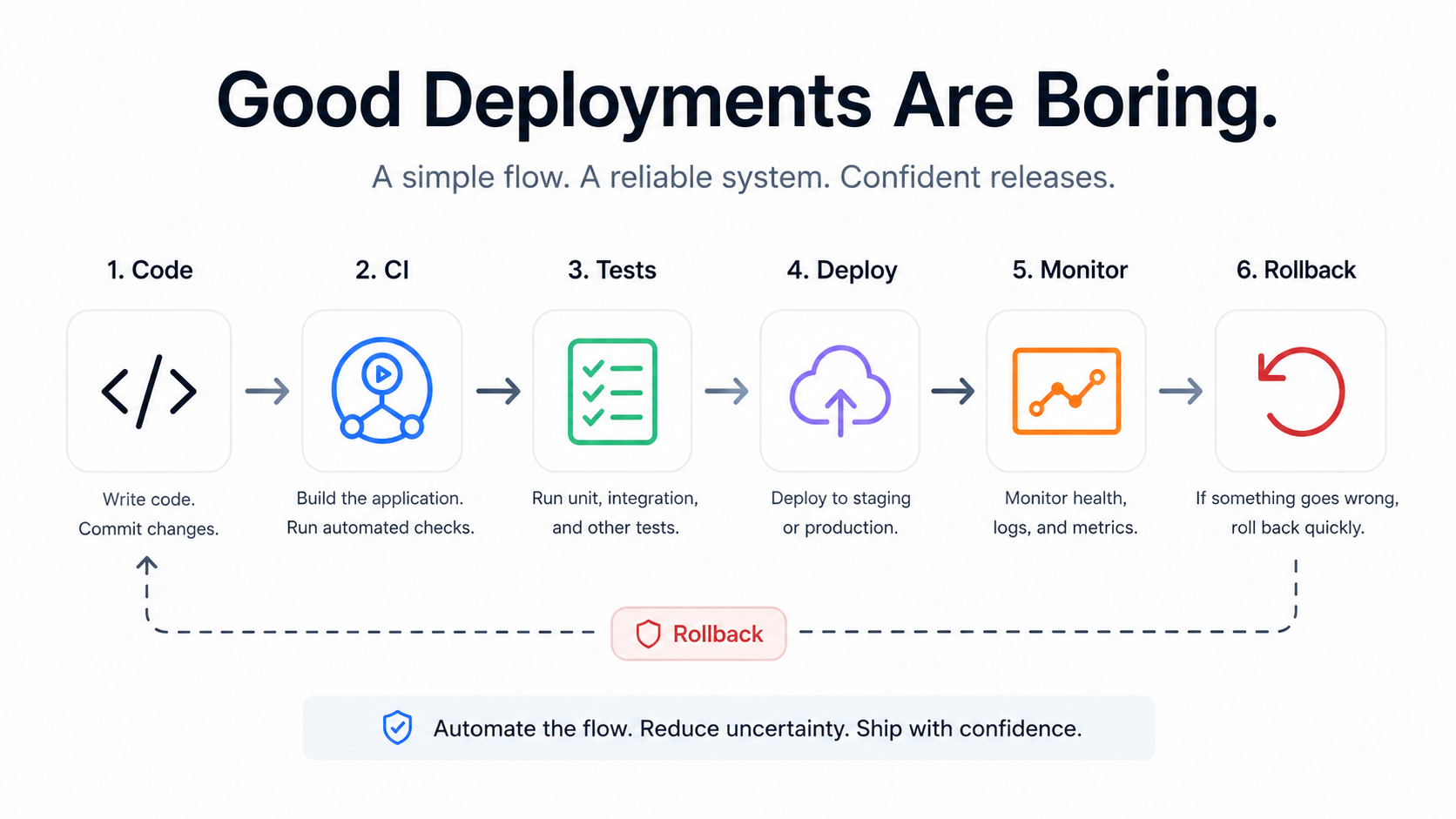
A deployment pipeline is not just a technical convenience for developers. It is part of how a business protects its ability to deliver change safely. Reliable tests reduce doubt. Monitoring reduces blindness. Rollback plans reduce panic. Automated steps reduce human error. Smaller releases reduce complexity.
Together, these practices change the experience of shipping software.
They make deployments less dramatic. They help teams move with confidence instead of hesitation. They create a system where releases are not acts of bravery, but routine operational work.
A deployment pipeline should make releases boring.
That is the point.